 Once upon a time there was a human race on Planet Earth, ruled by women and driven by sex.
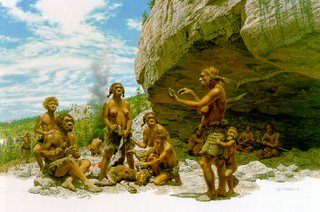
A human society with a fully structured social behavior that worshiped Goddess Moon and Goddess Nature.
Everything was shared within communal groups led by the most outstanding female individuals.
A clan that actually cared and provided for their youngest, elderly or ill.
And they must've been quite a valorous bunch, because they were willing to sacrifice themselves for the well-being of the group, as shown by the numerous bone fractures found on fossil remains, the result of intense fighting with awesome predators that trespassed their territory.
That society was the kind of social utopia that under today's conventional set of values, would likely be labeled as the wildest dream of a deranged feminist or a radical communist.
However, it all actually happened more than 100,000 years ago, and it went on that way uninterruptedly for a period lasting at least 50,000 years.
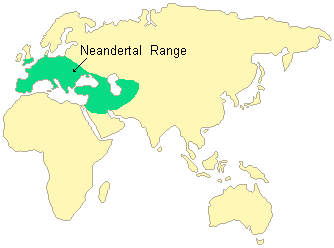
Although Neanderthal fossil evidence can be traced back as far back as hundreds of thousands years ago, it wasn't “only” until about 130,000 years ago, when they did fully evolve into what can be defined as human. At that time they began to spread across the European continent and by 80,000 years ago were occupying the whole area comprising Turkey and places of Western Asia all the way West to the Iberian Peninsula.
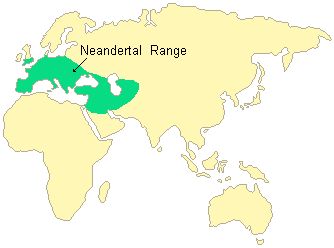 Then, about 45,000 years ago, another race of hominids came into the European scene. Out of Africa, the anthropoids currently believed to be our true human ancestors, had started to take positions at the Western Asian part of the Neanderthal range.
 They were taller, less hairy and stayed away from promiscuousness, living usually within a family nucleus and occupying a portion of land that was not open for sharing with anyone else. During the next 10,000 to 15,000 years, they kept expanding on northward and westward throughout all of Europe.
By the time the Cro-Magnons had accomplished the outspread in Europe, the Neanderthal people had completely vanished, leaving no fossil trace as to why or how.
They just seem to have disappeared in a very short period of time, never to be seen again in History.
But did they really vanished just like that?
From what we know out of anthropological data, both races coexisted in many areas during long periods of time. Strangely enough, no fossil evidence has been found of any kind of racial wars between the two distinct races.
Scientists nowadays, argue on whether interbreeding ever took place between the two races.
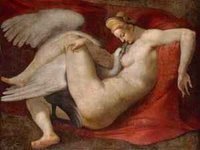 I am no scientist, but to put things into perspective, we need to take into account that all throughout History there's been copious evidence involving descendants of the most superior and civilized Cro-Magnon race, inflicting forced sex upon chickens, goats, horses, snakes and just about anything that moves, from several animal species, including fish or insects, plus more than a few episodes involving members of the Vegetable Kingdom.
It won't be too far off to think then, that there could have been some kind of interbreeding during the more than 10,000 years both races shared habitats. In fact, I am absolutely convinced that members from both races engaged in monumental orgies.
Neanderthals, being as they were, took the concept of community to the limit and surely must have lured at least some of the more reserved Cro-Magnons into their “open-minded” life-style.
Neanderthal society was communal, matriarchal and completely promiscuous, led by women and driven by sex (just as it happens in modern Spanish society and others from parts of Southern Europe, no matter what you've been told to believe).
On the other hand, Cro-Magnon communities followed the opposite set of rules. They were based upon the not very realistic idea of one partner for life, on a defined small piece of territory adjacent to other similar pairs. But since they had such a strong craving for conquering and looting, surely those activities must've lead to some raping as well, which opened another way for gene-crossing.
Or maybe, they got along just fine, made good friends and invited each other over on weekends to BBQ some mammoth hamburgers, how the heck should i know.
In any case, 10,000 years being close neighbors is a lot of time to seriously claim they didn't have sex with each other.
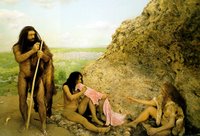 It was precisely that “open-minded” way of life together with their nomadness (again my own personal guess) what ultimately produced the demise of the Neanderthal population.
Some kind of sexually transmitted disease must have spread rapidly throughout the different communities, no-one having the type of medical training necessary to identify that unknown disease and its means of transmission.
And where that disease could have originated from?
Again, in my own uneducated opinion, the fact that the disease might have arrived at the same time that the Cro-Magnon people did, does not speak very well of the latest sex habits
As I said, examples of Cro-Magnons having sex with other species are plentiful, and that could have developed a new disease that was to spread globally killing millions. Just a wild guess that does not affect the original premise.
This exposition of facts may be considered as blasphemy by most anthropologists, but how else could you explain the complete vanishing without trace of a human race that had survived and successfully adapted throughout all kinds of climatic upheavals and fought off all kinds of terrifying predators for nothing less than 250,000 years.? Prove me wrong, please.
But why didn't the disease affect the Cro-Magnon people to the same extent, then?
Well, it surely must have affected them, but no to the same extent.
Being the original carriers they surely must've been able to identify and isolate the illness away from their communities. And thanks to their “one partner for life” way of life, most couples could have stayed away from unhealthy relationships.
After many generations had passed, people would have unconsciously started to gather empiric statistical data on people getting sick and their sexual habits, arriving to the conclusion that the “right” thing to do was to stay home with his/her partner and don't fool around. Does it sound familiar?
But the most intriguing thing is that precisely at the same time when all this pandemic and physiologic fluids exchange was undoubtedly taking place between the two races, there comes along a major technological and spiritual revolution, the first that mankind was to witness, one that was to be known as "The Human Revolution".
Previous to that encounter, neither Neanderthals nor Cro-Magnons could have met the standards required to qualify as “modern” humans.
Excuse again my lack of anthropologist training, but all this just cannot be coincidental.
But why were the Neanderthal and Cro-Magnon so different from each other?
That's an easy one to figure out:
Neanderthal evolved originally in bush or jungle conditions, hence his shorter average height (5' 4''), whereas Cro-Magnon evolved on open plains, hence his tallness. (average 5' 10'') and that he was appropriately long-sighted, and right-handed.
Other distinctive physical features of the Neanderthal people included prominent eyebrows and brow ridges, a larger cerebellum, nearsightedness and a higher incidence of left-handedness.
 And though they presented similar or even bigger cranial capacity as today's humans, on the average they seemed to posses a lower average IQ, as measured by Cro-Magnonian standards, that is.
Recent findings at Neanderthal excavation sites have brought out what is indisputably a flute, carved out of a bone. Music is undoubtedly one of the most elevated characteristics of human intelligence equal or higher than language, which must have obviously existed, then.
And if there was music, then there was dance. Throw in a few “magic” herbs and there you have all the ingredients needed to hold big social gatherings, i.e., big parties, that surely ended up in uninhibited orgies where women were in full control of the protocol.
Another of the distinct features that differentiated both races was the length of their big and second toe.
All Neanderthal fossil feet and footprints have been found to have the big toe shorter than the second toe. And all Cro-Magnon fossil feet and footprints found have been found to have the big toe longer than the second toe.
All, without exceptions.
Now, go to a public swimming pool and risk being taken for some kind of pervert. But after carefully watching, you'll see my point. It's a paleoanthropologist's nightmare. A collection of toes of all kinds of lengths and types that don't really correspond to the anthropological bodily appearance of the holders. Even within members of the same family, you can observe different toes' lengths and disposition.
This is not a banal issue. Paleoanthropologists argue that modern genes "derive exclusively" from the African ancestors of modern humans, and not from Neanderthals, based on genetic studies practiced on a few Neanderthal fossils.
But other anthropologists, contend that modern humans actually carry at least some genes of Neanderthals mixed in with their own.
It would be simplistic and easier to the mind to think that our Cro-Magnons ancestors were just better fitted for survival, and therefore we were the “chosen one” race, that overtook the ape-like Neanderthals.
Anyone who has visited Europe (specially the Mediterranean) has inevitably come across human specimens high on Neanderthal genes. North and South America have their share also, and the African and Asian continents hold sparse communities of almost pure Neanderthals and hybrids.
Carleton Coon dived into that unfortunate comparison in what he called the "Alpha and Omega" of living humans in his book The Origin of Races. Coon, also memorably remarked that a cleaned-up and soberly dressed Neanderthal would hardly merit a second glance on the New York subway.
When animal and plant breeders cross different species of plants and animals the resulting hybrid offspring has qualities and characteristics possessed by neither parent. This outcome is known as ‘hybrid vigor’.
But such vigor does not come along without some nasty side-effects, because it is also a well-known biological fact that when divergent species of animals are crossed, the offspring frequently show unstable behavior derived from the conflicting sets of instincts inherited from both parents.
And in the case of humans, that interbreeding between Neanderthal and Cro-Magnon must have produced two completely different sets of behavioral patterns, each one having found its own place in different sides of the brain. That would explain many aspects of the so-called “split-brain” theory.
And in that aspect, humans are also unique. No other animal can specialize each of their brain sides to perform different tasks, not at least to the degree we do, no matter how much training is provided.
So we all have a Neanderthal living in us, usually controlling the right side of our brains, but nonetheless, tradition and fashion dictates the Cro-Magnon type as the model to be followed, whether it'd be in fashion, movies or politics. Everyone thrives to have a tall, athletic figure. And almost everyone needs to follow a set of rules to live their lives coherently within modern societies. Or so we've been made to believe.
As it has been said, being tall and big is a very convenient body shape if you happen to live on open plains, but anywhere else it turns you into an oversized clumsy animal. In today's world, the larger you are the more bound you are to meet all kinds of missadaptation problems. Just ask any basketball player about it. And that's not going to get any better in the foreseeable future.
 But this is 2006 B.C., and being so new, humans as a whole are still so fascinated by the Cro-Magnonian life-style.
And the way we humans lead ourselves by nowadays is that whenever there's an interest, a market is rapidly developed to provide for it.
And once there is a market, it doesn't matter anymore whether the ideology behind it is outdated or wrong, because the beast is alive on its own and is constantly growing and asking to be fed.
That's the way Cro-Magnonian Capitalist Market works.
And that's why there's a conspiracy to promote even further the Cro-Magnon cause.
And I know they're after me for writing this post. They even hijacked my computer to certify the reports they were getting from their mentalists about a quasi-Neanderthal man discovering The First Truth. But I managed to sneak it in. And if they try to endanger my life now, they'll appear as prime suspects. So, I'm safe for the time being.
I consider myself to be quite Neanderthalish. I've got many of the physical traits, politically speaking I'd choose Left over Right any day of the week plus I have a secret fetish for women in dominant roles, so I must be one of them.
Besides, I understand no other intelligent way of human association than helping each other.
And I am a nomad, whether I like it or not.
And guess what. Neanderthals are more prone to paranoia and other ailments of the soul than Cro-Magnons are.
I also do posses more than my share of Cro-Magnon traits, such as an insane passion for technology or innate programming skills.
And there's nothing I dislike more than some human parasite trying to live off my work in order to improve his/her living standards. I also believe in private property to an extent, and my wife is not up for grabs, sorry.
Furthermore my
IQ of 145 is superior to that of most Neanderthals and Cro-Magnons alike. I got these measurements made in Australia, the country largely inhabited by the descendants of a misplaced community of European Cro-Magnon outcasts.
I arrived there in 1985, and my knowledge of the official English language was in need of vastly improvement, to put it kindly.
In spite of that, it didn't prevent me from coming up first by several legs at a test held to recruit possible candidates for a series of government subsidized computer programs. To me the test appeared to be more about common sense than anything else, really, and I went all through it non-stop, ticking away the obvious answers.
The results showed an IQ so high that prompted General Manager to come all the way from Melbourne headquarters to Sydney just to interview me. At least that's what I was told.
When I was first introduced to him, he looked sort of disappointed. He was clearly the Cro-Magnon type and was probably expecting to meet someone akin.
The conversation that followed has to be a classic of my experiences when dealing with all sorts of Cro-Magnon trained managers:
He looked me up and down and quickly went to the point informing me that it was to my best interest to spend approximately the next 3 to 5 years of my life subsidized studying FORTRAN and COBOL.
I thanked him, but pointed out that the real reason for applying was because I wanted to take one of the other courses available, and become a technician (that's where the meat is).
He implied he knew better than my own self about what were my best options.
I replied that if he was talking to me in the first place was because he thought I was smart. And if I was smart enough, then I should be able to decide about my own future.
That was the end of it, he didn't even let me apply for the technicians' course.
From information gathered later from former students of those primitive programming languages, I had made the right choice. One of them assured me it was far more complex than learning Chinese, but far less useful and gratifying. And he was fluent in both languages.
My more developed Neanderthal cerebellum also provides for some kind of unconventional intelligence, that gifts me with the ability, for example, to clearly identify patterns that would pass completely unnoticed by people high on Cro-Magnon genes.
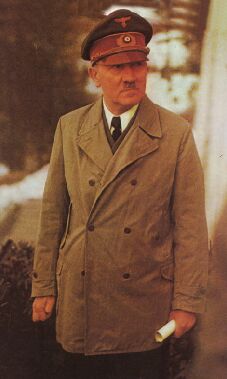
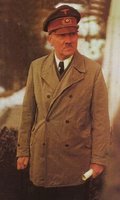
How come, for example, that a whole nation so Cro-Magnonish as Germany, could have let themselves be tricked into an absurd ideology about a superior Arial race and further on into a world war, by someone like
Hitler, himself a Neanderthal man posing as Cro-Magnon, who happened to be exactly the opposite image of an
Aryan race specimen?.
Let me tell you, that little phony man would have not deceived shit off me, not even for half a second.
And I know that you're thinking of
Franco now, the latest Spanish dictator, but that was a completely different thing. That was Cro-Magnonian Might (into which Nazi Germany actively contributed) crushing down by means of a destructive superior force, a popular Neanderthal-inspired freedom social movement.
It's the Neanderthal in me who is writing this post. Because, you see, my Neanderthal side can only express itself meaningfully in English. When it tries to do so in Spanish it makes little or no sense at all.
However, the Cro-Magnon in me loves using Spanish, probably because of its better order and structure (although he's fluent and meaningful in both languages).
I've got empiric proof that shows that the Neanderthal in me has taken refuge at the right side of my brain, which is the wrong side for an english-speaking Neanderthal (or english-speaking Cromagnon for that matter) to dwell in. But that was the only place it could fit, since there was no room left at the left side of my brain, entirely taken by my spanish education and its overwhelming cultural legacy.
I grew up in a country where as recent as half a century ago, left-handed pupils had their “good” hand tied up at their backs in order to force them to write using their “right” hand.
If there's a country where Left and Right collide in every sense, that's Spain. Just take a quick look at its
dwindling History.
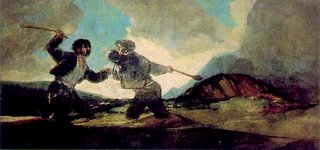
Spain could be defined as Neanderthal territory governed by strict and outdated Cro-Magnonian traditional ways.
For whatever the reasons, the Neanderthals' last redoubt thus seems to have been in Iberia, South and West of the Ebro. It is relevant here that while in certain other regions, Neanderthals of the 36-33 kyr period appear to have acquired some of the Cro-Magnons' behavioral attributes by acculturation, there is no evidence for this happening beyond the "
Ebro line", where abrupt cultural replacement appears to have been the rule.
The last of the Neanderthal that survived and interbred with the Cro-Magnon did pass on their genes and produced hybrids that are today's Iberians. And British ...
Up to recent times, people of Celtic ancestry were thought to have descended from tribes of central Europe. Nothing further from the truth.
Professor Sykes, who is soon to publish the first DNA map of the British Isles, said: "About 6,000 years ago Iberians developed ocean-going boats that enabled them to push up the Channel.
Before they arrived, there were some human inhabitants of Britain but only a few thousand in number. These people were later subsumed into a larger Celtic tribe ...
The majority of people in the British Isles are actually descended from the Spanish."
http://www.independent.co.ukIf you look at History, you'll see how hybrids from both countries, Spain and Britain, have defeated all other "pure" races and conquered about every corner of the world. And still had time to fiercely fight each other. Hybrid vigor.
There are still traditions in Spain that remind us of those ancient communal ways. The most representative is the custom to offer one's food to the rest of the people around you, sharing it with everybody if accepted. That's quite Neanderthal-like, I would say, and not a custom to be practiced almost anywhere else.
I left my country behind when I was 21, and headed for English-speaking Cro-Magnonian lands. I was utterly fascinated by their pragmatism, the directness and practicality of their language, together with their “non-bullshit” approach to things that really matter in a selfish life. So, for quite a few years, and in order to develop an acceptable set of language abilities, I immersed into every aspect of truly Cro-Magnonian societies, by living, working and breathing their culture for over 7 years, not ever going back to my homeland, neither writing back to friends and family that much, mostly because it did put me off my track and off my head.
I was so determined that I even shun away any contact with most of the spanish speaking travelers I'd occasionally met, and the truth is that I didn't miss it all that much.
At one point I even considered to overwrite the whole of my left side with the newly acquired English mentality. Today I'm so glad that I didn't.
All these traits are clearly Cro-Magnonish, but as I said, I had more than enough of that kind of mentality, with probably more than 75% of my brain occupied by egocentric ideas.
So I had to make the triple effort of learning a new language, accommodate it in a side that clearly was not its natural habitat to be in, and on top of that, make use of it to express my Neandertalish views.
I mostly use Spanish to express my Cro-Magnonian views, and that's plenty, thank you.
Luckily, more pragmatic English language allows for that kind of acrobatics that Spanish does not.
That's why I never succeed in properly translating what I write. None of what I'm writing would make much sense in Spanish. Vice versa sometimes, but not always.
If I am considered to be an odd character in the States, it's even worse in Spain, where I've been asked a worrying number of times whether I come from outer space (and I'm not kidding now).
To help you get the picture, Spain is the kind of place where
Stephen Hawking would probably have gotten beaten up for being such a smart-aleck.
To be honest, the country has changed a lot during the past 30 years or so, but the remains of hundred years of
Spanish Inquisition plus 40 recent years of imposed ignorance and fear are still deeply rooted in its culture and it certainly shows. I calculate that it will take at least 2-3 generations to get rid of those bad Cro-Magnon habits, if that ever happens.
The current system education of choice (a.k.a. The Box), is not helping either. Spaniards are very fond of indulging in watching TV programs primarily designed to sell worthless products and promote ignorance. A run-down version of professional Cro-Magnonian media.
My Cro-Magnonian side is now telling me not to veer off and conclude at once.
No one can refute the fact that the Cro-Magnon mind-set has been the prime accountable for most of the technical gadgetry some of us enjoy today. And no one will deny (or almost no one) taking proper advantage of that technology to improve the quality of their lives.
And the truth is that it's been real “fun” for a several-thousand-of-years while, with all those bloody wars, which in turn spurred phenomenal advances in weaponry, communications or medicine.
But now the time for change is overdue. This egocentric Cro-Magnon mentality has pushed the natural resources of our planet beyond their limits and is driving us fast-forward towards our own self destruction.
Even if we're just meaning to be selfish, we still are in great need of a major mentality shift.
We need to get back to our Neanderthal roots and start caring for each other again, at least until we have properly digested all the technical advances falling and looming upon us.
And we must do this as fast as possible, because maybe it's already
too late.
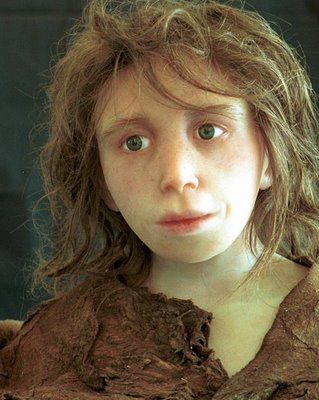 More Info
:
Hybrid-originHuman evolutionThe Way We AreCities of Dreams – Stan Gooch The Dream Culture of the NeanderthalsCro-Magnon Man and the BibleMax Planck Institute for Evolutionary Anthropology